
Privilege Signs and the Ghosts Left Behind.
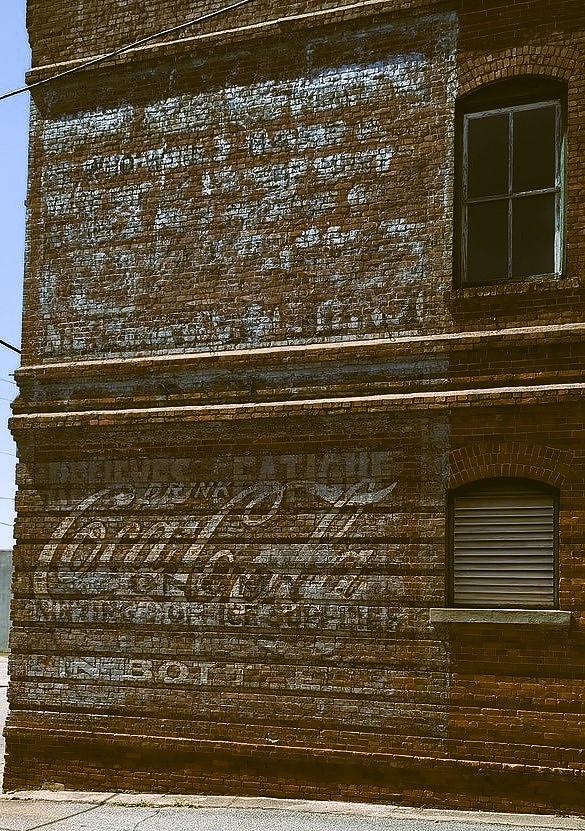

I'm a huge fan of Coca-Cola ghost signs which were painted advertising in most southern US towns. Many of them have completely faded away, been painted over, or worse yet "restored" which to my thinking is a worse fate. Here is some history about the signs themselves from my research lately.
Coca-Cola and the "Privilege Sign"
Coca-Cola has deep roots in the South, and its wall signs are the most ubiquitous ghost signs in South Carolina. This was the result of a brilliant marketing strategy pioneered by the company's early leadership. Coca-Cola utilized a concept called the "Privilege Sign." The company would approach local South Carolina merchants—pharmacies, corner groceries, and general stores—and offer to paint the entire side of their brick building for free. The catch? The top or bottom fraction of the wall would feature the name of the local store (e.g., "Smith's Pharmacy"), but the vast majority of the wall would be dedicated to a massive Coca-Cola advertisement. This allowed Coca-Cola to plaster its brand across every small town in South Carolina while endearing itself to local business owners.
The Palimpsest Effect
If you look closely at the image, you can see faint, blocky lettering behind and above the Coca-Cola script. This is known as a palimpsest—a surface where older writing has been painted over but remains partially visible.
In South Carolina's growing downtowns, prime wall space was frequently leased and re-leased. A wall might advertise a local livery stable in 1890, be painted over for a local hardware store in 1905, and then painted over again by a national brand in 1920. As the top layers of paint weather away, the different eras bleed into one another, creating a layered historical document of the town's commerce.
The Era of the "Walldogs"
From the late 19th century through the 1950s, before the advent of vinyl billboards or digital advertising, the sides of commercial brick buildings were prime real estate. The men who painted these massive advertisements were affectionately (and sometimes derisively) known as "Walldogs." These artisans were often itinerant, traveling from town to town across South Carolina. They dangled from the sides of three-story buildings on simple wooden swing stages (scaffolding), braving the sweltering Southern heat. They mixed their own paints on-site, relying heavily on white lead paint. This lead base is the exact reason these signs still exist today; while the vivid pigments (like Coca-Cola's signature red) eventually washed away in the rain and sun, the lead strongly bound itself to the porous masonry, calcifying and leaving a permanent "ghostly" imprint on the brick.
The legacy here in South Carolina
Jim Harrison, who lived in Denmark, South Carolina is famous not only for his start painting walls and barns, but later as a painter who captured these in paintings and calendars for the Coca-Cola company. You can visit his museum and see more of his art on his website https://jimharrison.com/
